Backup Power for Medical Devices: CPAP, Oxygen Concentrators, Nebulizers and More
By Hilario Herrera · Last updated ·Research-based guide · Some links are paid links (disclosure).
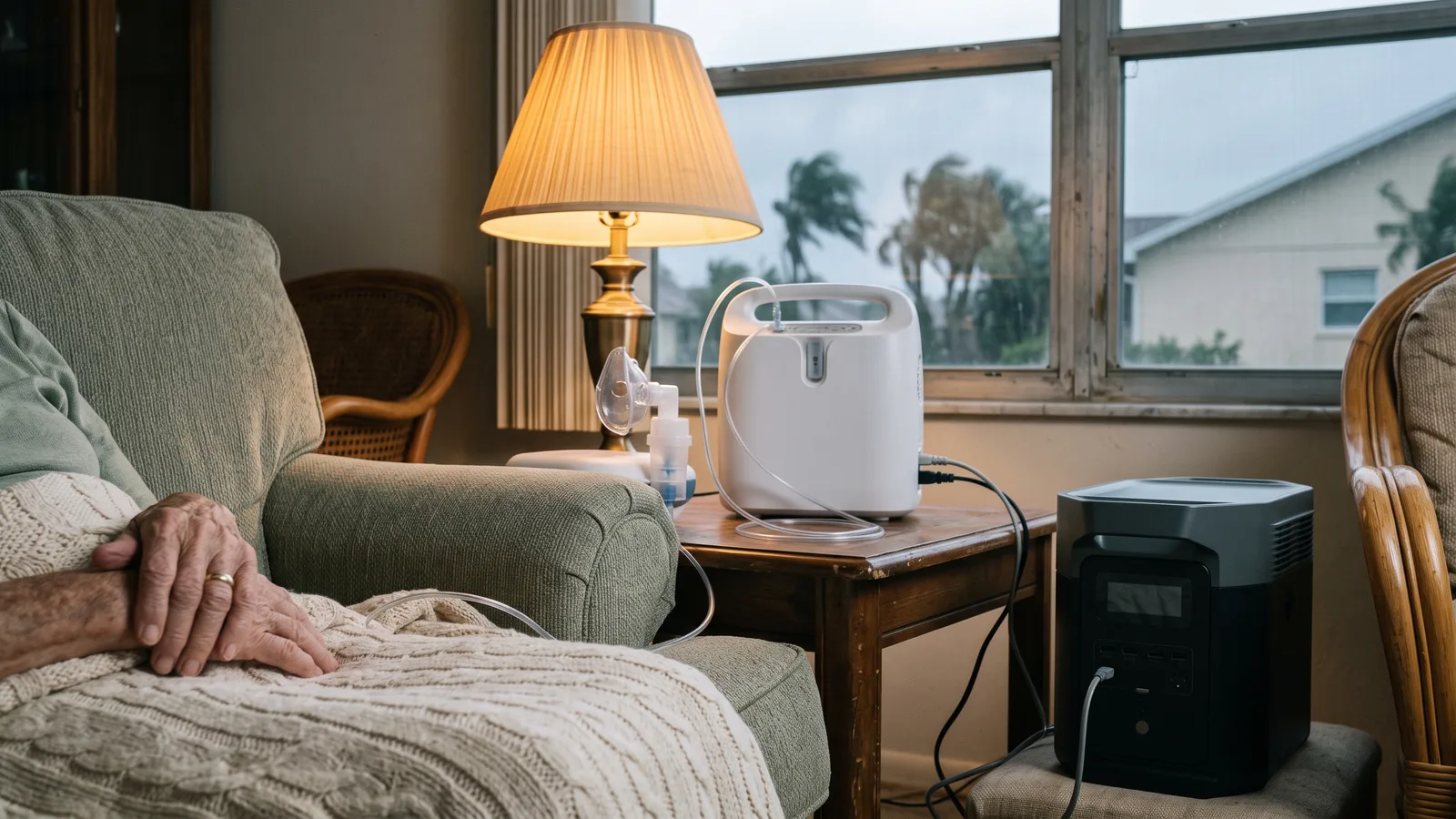
Quick answer: Most home medical devices need between 200Wh and 900Wh per night. A CPAP without heated humidification uses about 240–320Wh for eight hours; a portable oxygen concentrator uses about 300–600Wh; a home (stationary) oxygen concentrator uses 2,400–4,800Wh and is generally too large for a portable power station. Size the battery to the device, not to the house.
If someone in your home depends on powered medical equipment, an outage is not an inconvenience — it is a clock. This guide gives you the actual numbers so you can size a battery correctly instead of guessing.
This is an energy-math guide, not medical advice. Confirm your specific device’s requirements with its manufacturer and your care team. Your equipment supplier can usually tell you the exact draw and whether a manufacturer-approved battery exists.
Consumption by device
| Device | Typical running draw | Energy per 8-hour night | Notes |
|---|---|---|---|
| CPAP, humidifier off | 30–40W | 240–320Wh | Run the DC cord if available |
| CPAP, humidifier + heated hose | 70–95W | 560–760Wh | Roughly triples consumption |
| BiPAP | 40–60W | 320–480Wh | Higher pressures draw more |
| Portable oxygen concentrator (pulse) | 40–75W | 320–600Wh | Pulse mode is far cheaper than continuous |
| Home oxygen concentrator (5 LPM) | 300–600W | 2,400–4,800Wh | Needs a 2kWh+ station minimum |
| Nebulizer | 60–180W | ~20Wh per treatment | Brief, intermittent |
| Feeding pump | 5–15W | 40–120Wh | Very light load |
| Power wheelchair charger | 80–200W | 400–1,000Wh per charge | Charge during daylight on solar |
| Insulin cooling / 12V fridge | ~45W avg | 250–400Wh per day | See the insulin guide below |
Figures are typical values from manufacturer specifications; check the label on your own unit.
The single biggest lever: turn off heated humidification
For CPAP users this is the difference between a small battery and a large one. Heated humidification and a heated hose are resistive heating elements, and they roughly triple a CPAP’s consumption — from about 40W to as much as 95W.
The verdict: for a CPAP user in a Florida outage, running the machine with humidification off on a 1kWh station is the better setup — it delivers two to three nights instead of one, and Florida’s ambient humidity makes the humidifier largely redundant — unless your prescription specifically requires it, in which case size for 760Wh per night and plan on solar recharging.
Also worth knowing: many CPAPs accept DC input directly, which skips the inverter entirely and saves the ~15% AC conversion loss. Ask your supplier for the DC cord for your model.
Sizing recommendations
One night, CPAP or portable oxygen, humidification off — a 300Wh class unit such as the Jackery Explorer 300 covers a single night with little margin (paid link). Treat this as a minimum, not a plan.
Three nights, or one night with humidification — a 1kWh station such as the EcoFlow DELTA 3 Plus or Anker SOLIX C1000 Gen 2 is the realistic floor for medical dependence (paid links). This is the tier most Florida households should buy.
Medical device plus refrigerated medication plus fans — the 2kWh+ class, such as the Anker SOLIX F2600 (paid link). This runs a CPAP, a 12V fridge for medication, and a fan through a multi-day outage.
A home oxygen concentrator — this is the hard case. At 300–600W continuous, a 4kWh EcoFlow DELTA Pro 3 delivers roughly 7–11 hours (paid link). Anyone dependent on a stationary concentrator needs either a whole-home solution, a generator, or an evacuation plan — not a portable battery alone.
Always buy the recharge, not just the battery
A battery is a fixed number of hours. Solar makes it renewable. For medical loads this is not an upgrade — it is the difference between a plan and a countdown.
A Renogy 200W portable panel harvests roughly 700–900Wh on a clear Florida day (paid link) — enough to fully replace one to three nights of CPAP use every single day the sun is out. Pair it with any 1kWh station and a CPAP user is effectively covered indefinitely.
Register for utility medical priority — it is free
Every major Florida utility maintains a Medically Essential or special-needs customer registry. Registering does not guarantee your power is restored first, but it does flag your address for restoration prioritization and advance notice of planned outages.
- Florida Power & Light — Medically Essential Service program
- Duke Energy Florida — Medical Alert / Life Support registration
- Tampa Electric (TECO) — Medically Essential Service
Separately, register with your county’s Special Needs Shelter program through Florida’s Special Needs Registry. County shelters that accept special-needs registrants provide powered outlets for medical equipment. Both registrations typically require a physician’s signature, so do this before hurricane season, not during a watch.
Your outage checklist for a medical household
- Know your device’s actual watts — read the label, not the marketing copy
- Test the full setup once, before you need it — run the device on the battery for an entire night
- Keep a manual backup where one exists — a manual resuscitator bag, a non-powered nebulizer alternative, a manual wheelchair
- Charge everything to 100% when a watch is issued, not when the warning hits
- Register with your utility and county ahead of the season
- Have an evacuation trigger written down — a specific battery percentage or hour count at which you leave for a shelter or a friend with power
- A CO detector is non-negotiable if any generator will run nearby (paid link)
Frequently asked questions
Can I run a CPAP off a car battery? Yes, through a DC inverter (paid link), but a car battery is a starting battery and is damaged by deep discharge. A typical car battery can supply roughly one night of CPAP use before it may no longer start the engine. A power station is the far better tool.
Does Medicare or insurance cover a backup battery? Generally not for portable power stations. Some manufacturers’ device-specific battery packs are covered as durable medical equipment in limited circumstances. Ask your equipment supplier before assuming either way.
How do I know how many watts my device uses? Check the label on the device or its power supply — it will list either watts or volts and amps (volts × amps = watts). A plug-in watt meter gives you real measured draw, which is often lower than the label’s maximum.
Is a generator or a battery better for medical equipment? A battery, for the device itself. It is silent, produces no carbon monoxide, works indoors, and delivers clean power. Use a generator to recharge the battery during a long outage — never to power sensitive medical equipment directly from a non-inverter unit.