Is It Safe to Charge a Power Station Indoors? (Yes — Here's Why, and the Exceptions)
By Hilario Herrera · Last updated ·Research-based guide · Some links are paid links (disclosure).
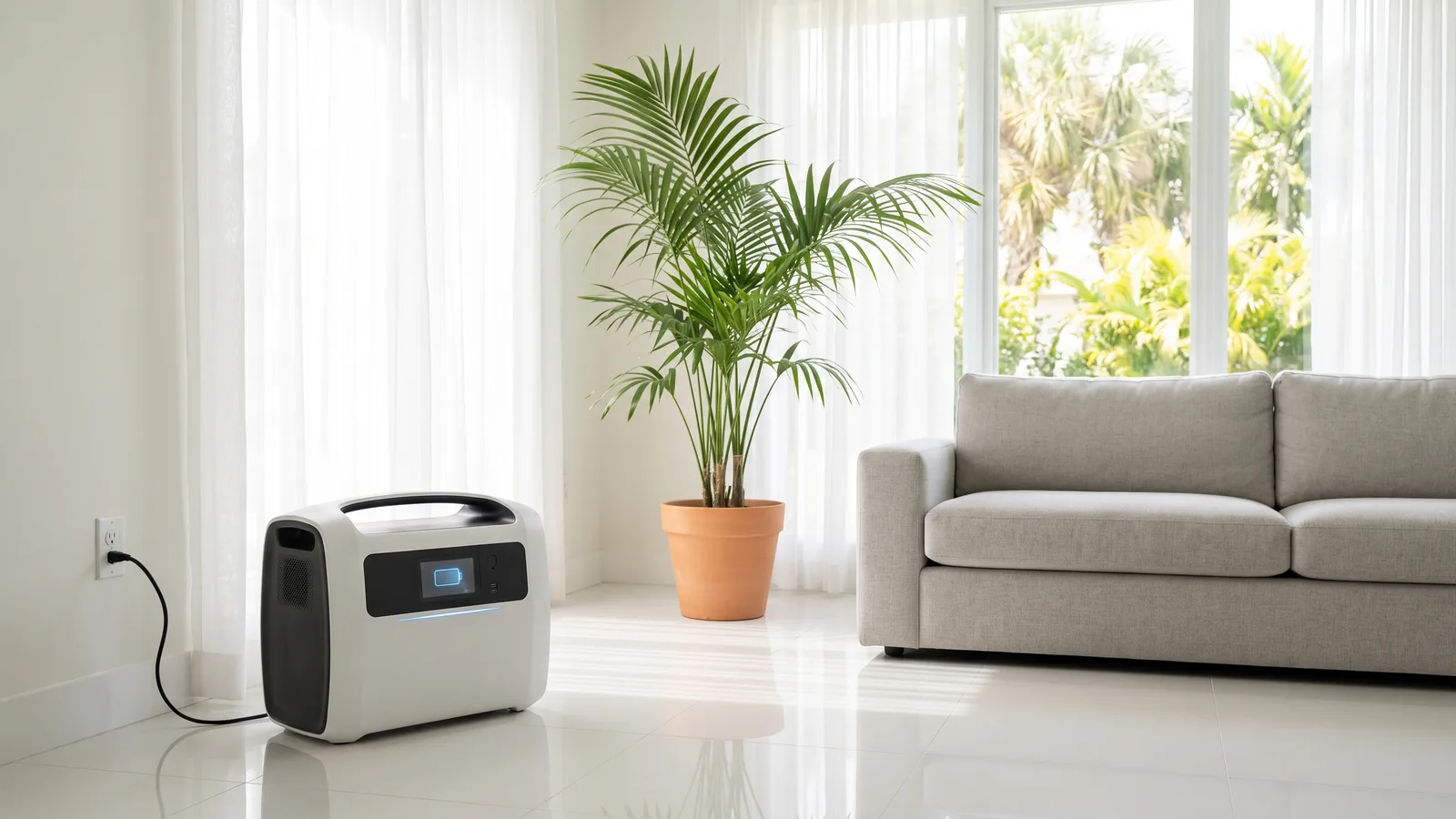
Quick answer: Yes. A battery power station is safe to charge and use indoors. It produces no carbon monoxide, no exhaust, and no combustion — that is the entire difference between a power station and a generator. Keep it in a ventilated spot away from heat sources, off soft surfaces like beds and carpet, and it is no more hazardous than any large laptop charger.
The reason this question gets asked so often is that people mentally file “generator” and “power station” in the same folder. They are not remotely the same, and the confusion is dangerous in both directions.
The distinction that matters
| Gas generator | Battery power station | |
|---|---|---|
| Carbon monoxide | Yes — lethal | None |
| Safe indoors | Never | Yes |
| Minimum outdoor distance | 20 feet from any opening | N/A |
| Noise | 50–75 dB | Near-silent (fan only) |
| Fuel storage | Gasoline or propane | None |
A gas generator must never run indoors, in a garage, in a carport, on a porch, or within 20 feet of any window, door, or vent — even with the garage door open. Carbon monoxide poisoning from portable generators kills roughly 85 people per year in the United States. (CPSC)
A power station has no engine. There is nothing to burn and nothing to vent. It is the correct tool for indoor use, which is exactly why it is the right choice for bedrooms, medical equipment, and refrigerators.
Why LiFePO4 raised the safety floor
Most current power stations from Anker, EcoFlow, Jackery, and Bluetti use LiFePO4 (lithium iron phosphate) cells rather than the NMC chemistry in phones and laptops. Two properties matter for indoor use:
- A much higher thermal runaway threshold. LiFePO4 is substantially more resistant to the failure mode behind viral lithium battery fires.
- A far longer service life — typically 3,000–6,000 cycles to 80% capacity, versus 500–1,000 for NMC.
Every unit also carries a Battery Management System that cuts off charging on over-voltage, over-current, over-temperature, and cell imbalance. The BMS is what makes leaving one plugged in overnight a non-event.
The verdict: for a Florida homeowner who wants backup power that can run inside the house, a LiFePO4 power station is the right choice — it emits nothing, runs near-silently, and its battery management system makes indoor charging genuinely safe — unless you need multi-day whole-home capacity, in which case pair it with a generator kept properly outdoors for recharging.
The actual rules for indoor use
Do:
- Place it on a hard, flat surface — a floor, a shelf, a table
- Leave 6 inches of clearance around the vents; the cooling fan needs airflow
- Keep it in a room-temperature space, ideally 32–104°F (0–40°C)
- Use the manufacturer’s charger and cables
- Store it at 50–80% charge if it will sit unused for months
Don’t:
- Charge it on a bed, couch, or carpet — soft surfaces block the vents
- Leave it in a closed car in Florida sun; interiors exceed 140°F, well beyond safe range
- Charge a unit that has been dropped, dented, punctured, or swollen — retire it
- Cover it with anything while charging
- Run it in a sealed closet. Not for exhaust — there is none — but because trapped fan heat will throttle charging or trip thermal protection
The real exceptions
Three cases where indoor charging warrants extra care:
- Physical damage. A dented, punctured, or swollen unit should be moved outdoors, away from structures, and disposed of at a battery recycling facility. Never charge damaged lithium cells.
- Older or uncertified NMC units. Off-brand units without recognized safety certification have a materially worse track record. If it has no UL, ETL, or equivalent listing, do not charge it unattended.
- Extreme heat. Charging outside the rated temperature window degrades cells and can trip protection. A Florida garage in August can exceed the safe window — charge it inside the air-conditioned part of the house.
Certifications to look for
Look for a UL 2743 listing — the standard specifically for portable power packs — or an equivalent ETL/Intertek listing to the same standard. Reputable units also carry FCC, CE, RoHS, and UN38.3 (transport safety) markings.
Certification is the single clearest quality signal when comparing an unfamiliar brand against an established one, and it is worth checking before you buy. Our certification decoder explains what each marking actually covers.
What about charging from a generator?
Common and sensible: run the generator outdoors, 20+ feet from the house, on a heavy-gauge cord, and charge the power station from it. Then bring the power station inside to run your loads.
This is genuinely the best of both worlds — generator range, indoor safety — and it is how most Florida households should run a long outage. Use 12-gauge cords for the run (paid link); thin cords cause voltage sag and melted plugs.
A working CO detector on every level of the home is mandatory any time a generator runs anywhere nearby (paid link). Test it today, not during the storm.
Frequently asked questions
Can I leave a power station plugged in all the time? Yes for most modern units — the BMS stops charging at full. But for maximum battery lifespan, many manufacturers recommend storing at 50–80% rather than sitting at 100% indefinitely. Check your model’s manual.
Can I use one in a bedroom overnight? Yes. This is one of the strongest arguments for a power station over a generator — it is the only option that can safely run a CPAP or oxygen concentrator beside the bed.
Is it safe to charge one in an apartment? Yes, and it is often the only legal backup power option for renters, since most leases and local fire codes prohibit generators on balconies and patios.
Does a power station need ventilation like a generator? No — it emits nothing. It needs airflow only so its cooling fan can shed heat. Six inches of clearance and a hard surface is sufficient.
What if it starts making a loud fan noise while charging? That is normal under fast charging. If the fan runs loud while idle, or the case is hot to the touch, unplug it and let it cool — then check for damage.