How Long Food Stays Cold in a Power Outage (Fridge and Freezer Hold Times)
By Hilario Herrera · Last updated ·Research-based guide · Some links are paid links (disclosure).
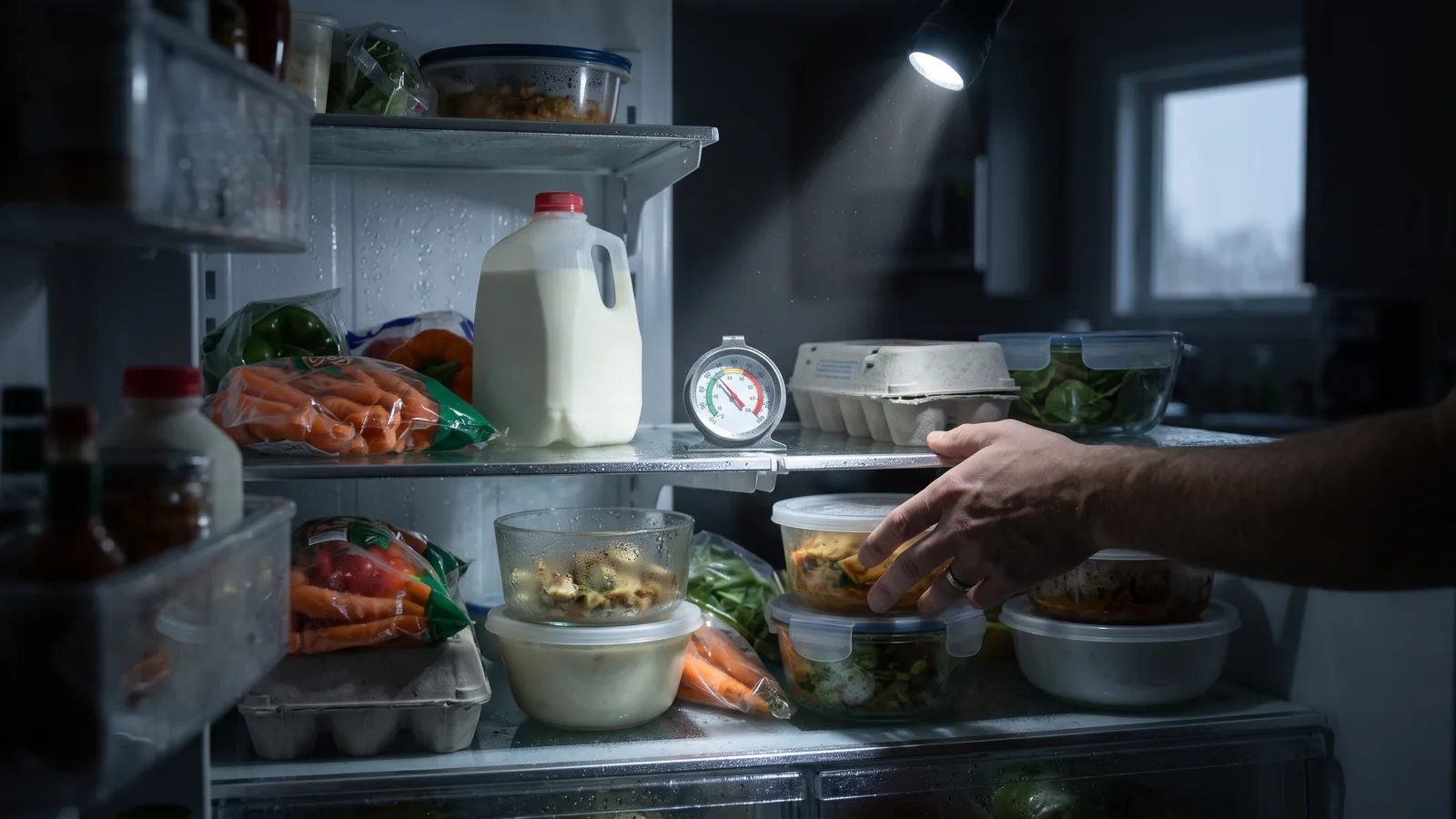
Quick answer: With the door kept closed, a refrigerator holds food safely for about 4 hours without power. A full freezer holds about 48 hours; a half-full freezer holds about 24 hours. Those are USDA figures, and they assume the door stays shut the entire time. (USDA Food Safety and Inspection Service)
That single paragraph is the number most people are looking for. The rest of this guide is the part nobody publishes: what those hold times actually assume, how fast they collapse in Florida heat, and the watt-hour math for running the fridge instead of racing the clock.
The hold-time table
| Appliance | Condition | Safe hold time (door closed) |
|---|---|---|
| Refrigerator | Any | ~4 hours |
| Freezer | Full | ~48 hours |
| Freezer | Half full | ~24 hours |
| Cooler + ice | 40°F or below maintained | Indefinite, while ice lasts |
The safety threshold is 40°F. Perishable food held above 40°F for more than two hours should be discarded. The rule that matters most: when in doubt, throw it out — you cannot judge bacterial growth by smell or appearance.
What the USDA numbers quietly assume
The 4-hour and 48-hour figures assume a room-temperature house. In a Florida outage, the air conditioning is off too. An interior that climbs to 88°F pulls heat through the cabinet walls faster than the test conditions assume, so treat those numbers as a ceiling, not a promise. Plan closer to 3 hours for the fridge and 36 hours for a full freezer if the house is hot.
Two practical consequences:
- A full freezer outlasts an empty one by 2×. Frozen mass is thermal ballast. If a storm is 48 hours out, fill empty freezer space with jugs of water — they freeze solid and buy you a day.
- Every door opening costs you. A single 30-second look resets a meaningful share of the cold you were banking. Decide what you need before you open it.
The 5-hour gap that ruins a fridge full of groceries
Here is the real problem. Florida outages routinely run 8 to 72 hours. Your refrigerator is safe for 4. That gap — roughly hours 4 through 72 — is where a few hundred dollars of food is lost, and it is exactly the gap a power station closes.
How much battery does a refrigerator actually need?
A modern full-size refrigerator draws about 150W while the compressor runs, but the compressor only runs about 30–50% of the time. That duty cycle is the whole reason a fridge is cheaper to back up than people expect.
Real daily consumption: roughly 1,000–1,500 watt-hours per 24 hours for a standard full-size unit.
| Power station | Usable capacity (×0.85) | Fridge-only runtime |
|---|---|---|
| Jackery Explorer 300 (292Wh) | 248Wh | ~5 hours |
| EcoFlow DELTA 3 Plus (1024Wh) | 870Wh | ~17 hours |
| Anker SOLIX C1000 Gen 2 (1024Wh) | 870Wh | ~17 hours |
| Anker SOLIX F2600 (2560Wh) | 2176Wh | ~42 hours |
| EcoFlow DELTA Pro 3 (4096Wh) | 3482Wh | ~67 hours |
Runtimes assume ~50Wh/hour average fridge draw (150W at a 33% duty cycle) and 85% inverter efficiency. Paid Amazon links (disclosure).
The verdict: for a Florida homeowner trying to save a full refrigerator through a typical multi-day outage, a 1kWh station plus a 100–200W solar panel is the right buy — it covers roughly 17 hours on battery alone and recharges enough each day to run indefinitely — unless you also need to back up a medical device or window AC, in which case go straight to the 2kWh class.
Solar is what turns “a day and a half” into “as long as the sun comes up.” A Renogy 200W portable panel harvests roughly 700–900Wh on a clear Florida day — approximately one full day of refrigerator consumption (paid link).
The cheaper play: a 12V fridge
If your goal is only to keep medication, milk, and a few days of food cold — not to save an entire full-size refrigerator — a 12V compressor fridge changes the math completely. A BougeRV 23QT 12V fridge averages roughly 45W while running, about 250–400Wh per day (paid link).
That is a quarter of a full-size fridge’s consumption. Even a 300Wh station runs one for most of a day, and a 1kWh station runs one for three days without solar.
What to do in the first four hours
- Do not open the doors. Write down what you need before the power goes out.
- Move the most valuable perishables to the freezer in the first minutes, while it is still deeply cold.
- Put an appliance thermometer in each compartment. After a long outage, the thermometer reading is the only reliable evidence of whether food stayed below 40°F.
- Fill empty freezer space with water jugs or bags of ice.
- Start the power station on the fridge before the fridge warms up. Cooling a warm box costs far more energy than holding a cold one.
Frequently asked questions
Is food safe if the freezer is still full of ice crystals? Yes. Food that still contains ice crystals or is at 40°F or below can be safely refrozen, though texture and quality may suffer. This is the USDA’s standard guidance.
Can I plug a refrigerator into any power station? Check the surge rating, not the running watts. A fridge compressor briefly pulls 3–6× its running draw at startup. A station rated for 1,800W or more of surge handles nearly any residential refrigerator; small 300W units generally cannot start one at all.
How long will a chest freezer last compared to an upright? Longer. Cold air sinks, so a chest freezer loses far less cold when opened, and its typically better insulation extends hold times past the 48-hour figure.
Should I use dry ice? It works — roughly 50 lbs holds a full freezer for about two days — but it must be handled with gloves and requires ventilation. Never handle it barehanded or store it in a sealed container.