Whole-House Generator vs. Power Station: Real Cost Comparison for Florida Homes
By Hilario Herrera · Last updated ·Research-based guide · Some links are paid links (disclosure).
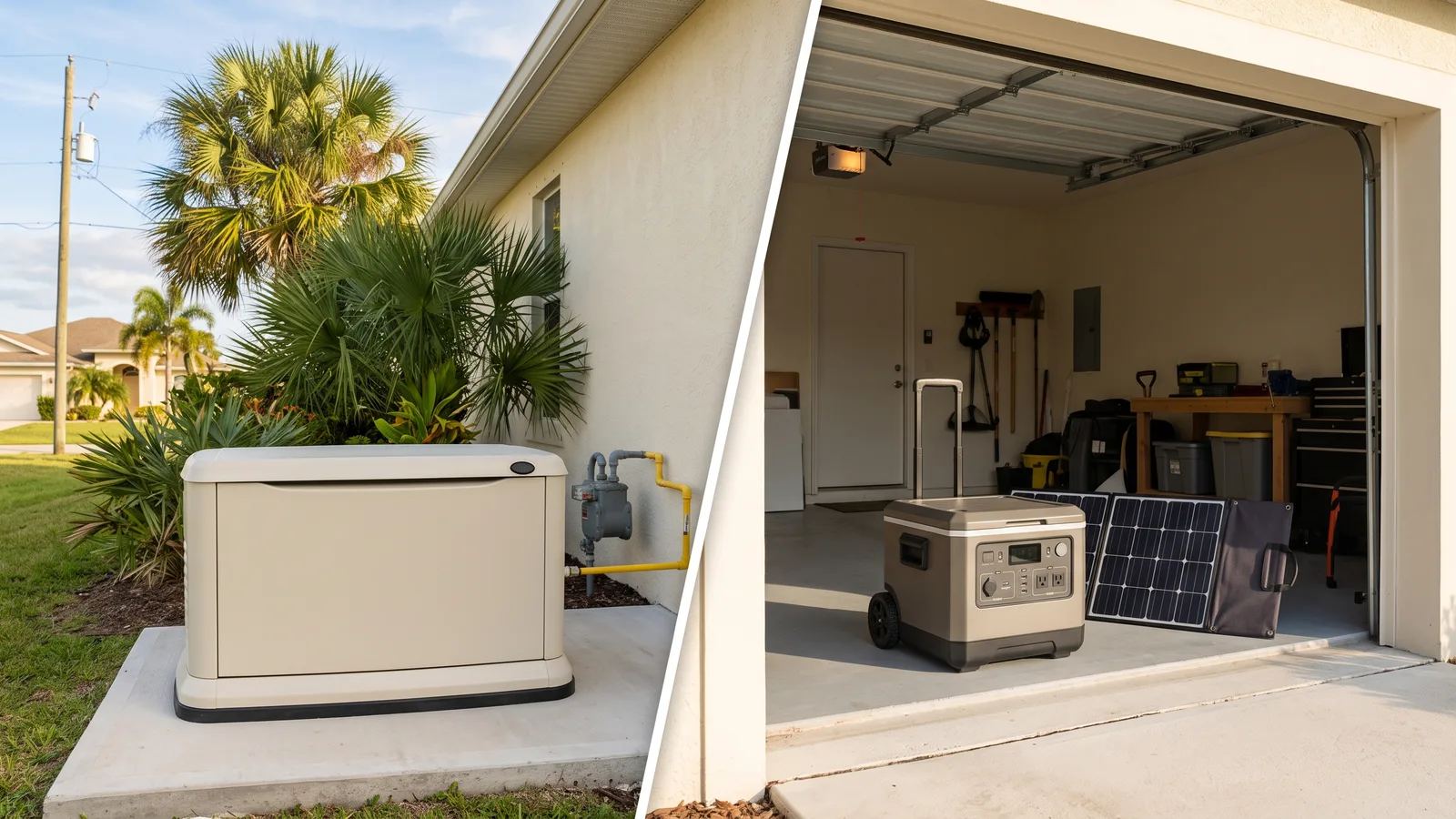
Every Florida homeowner asks the same question after the first hurricane watch of the season: do I buy a standby generator, or is a battery power station enough? The honest answer is “it depends on your budget and how long you expect to lose power,” but the cost math is more nuanced than most articles let on. Here’s a grounded, numbers-first comparison.
Quick picks
- Best whole-house standby generator: Generac Guardian 22kW — automatic transfer switch, runs on natural gas or propane
- Best portable/inverter generator backup: Honda EU2200i — quiet, reliable, easy to store
- Best large power station for essentials: EcoFlow Delta Pro 3 — expandable battery capacity, solar-chargeable
- Best mid-size power station: Jackery Explorer 2000 Plus
How the two options actually differ
A whole-house standby generator is a permanently installed system, hardwired to your electrical panel through an automatic transfer switch. When utility power drops, it senses the outage, starts itself (usually on natural gas or propane), and restores power to your whole home within seconds — no manual setup required.
A power station is a large battery pack with built-in inverter and outlets. You charge it in advance (from the wall, your car, or solar panels), then plug appliances directly into it or connect it to a subset of circuits during an outage. It has no fuel to buy and makes no noise, but its capacity is finite — once the battery is empty, you’re recharging or waiting for grid power to return, unless you have solar panels to top it back up.
Upfront and installed cost
| Item | Typical cost or price tier (2026) |
|---|---|
| Whole-house standby generator (unit only, 20-26kW) | $5,000–$8,500 |
| Professional installation (transfer switch, gas line, permit) | $3,000–$6,000 |
| Total installed standby system | $8,000–$14,500 |
| Portable inverter generator (2000-3000W) | Mid-range tier |
| Large power station (2-3kWh, e.g. Delta Pro 3, Explorer 2000 Plus) | Premium tier |
| Power station + 400-800W solar panel kit | Premium tier |
Standby generators cost roughly 3-5x more once you factor in installation, which typically requires a licensed electrician, a gas line from a licensed plumber, and a county permit — all standard in Florida jurisdictions and often mandatory for insurance or HOA compliance.
Running cost and fuel logistics
Standby generators sip fuel from your home’s natural gas line (if you have one) or a propane tank you maintain. A 22kW unit burns roughly 2-3 gallons of propane per hour under moderate load, so a 250-gallon tank can realistically run the house for several days continuously. Natural gas hookups are effectively unlimited as long as the utility’s gas lines stay pressurized, which is usually more reliable than the electric grid during storms.
Power stations have no ongoing fuel cost, but their capacity is fixed. A 3kWh unit like the Delta Pro 3 will run a refrigerator, some lights, phone chargers, and a WiFi router for roughly a day before needing a recharge — either from a wall outlet (if power returns), a car’s 12V outlet, or solar panels. In multi-day outages without sun, that becomes the limiting factor.
Maintenance
Standby generators need annual servicing — oil changes, battery checks, and self-test cycles (most units run a 5-10 minute self-test weekly automatically). Budget $150-$300/year for a maintenance contract, similar to servicing an HVAC system, and always in a well-ventilated outdoor space per manufacturer instructions.
Power stations require almost no maintenance beyond occasional top-off charging to prevent the lithium battery from sitting fully depleted for long periods. Most modern units, including the EcoFlow and Jackery lines, use LiFePO4 (lithium iron phosphate) cells rated for 3,000-6,000 charge cycles, which manufacturers estimate at 10+ years of typical use.
Which one fits your situation
Choose a whole-house standby generator if: you own your home long-term, you need to run central AC and well pumps, you’re in a rural area with longer restoration times, or you have medical equipment that cannot tolerate any gap in power.
Choose a power station if: you rent or live in a condo/HOA that restricts fuel-burning equipment, you want silent and fume-free operation, your outages are typically short (hours, not days), or your budget tops out under $3,000.
Choose a portable gas/inverter generator if: you want generator-level power without the installation cost, and you’re comfortable storing and rotating gasoline safely and running the unit outdoors, at least 20 feet from the house, per CO safety guidance.
Many Florida households land on a hybrid approach: a portable inverter generator or power station for routine short outages, with plans to add a standby system once budget allows — especially homeowners in flood-prone or barrier-island areas where multi-week restoration after a major hurricane isn’t unusual.
FAQ
Can a power station run central air conditioning? Generally no. Central AC compressors typically draw 3,500-5,000 running watts with a large startup surge, which exceeds what most consumer power stations (even 3,000W-rated units) can sustain, especially combined with other loads. Standby generators sized 20kW+ are built for this.
Do I need a permit for a standby generator in Florida? Yes, virtually all Florida counties require an electrical and often a fuel-line permit, plus inspection. Reputable installers handle this as part of the quote.
Is a portable generator safe to run during a hurricane? Only outdoors, never in a garage or under a covered porch, and always at least 20 feet from windows and doors, per CPSC and CDC carbon monoxide guidance. Use a battery-powered CO detector inside the home regardless.
How long will a power station last on a full charge? Depends entirely on what you run. A fridge alone might draw 1-2kWh per day; add a CPAP, lights, and phone charging and expect a 2-3kWh power station to last roughly 18-30 hours between charges.
Can I add solar panels to either option? Yes to power stations directly — most EcoFlow and Jackery units accept portable solar panels. Whole-house generators are a separate system from home solar/battery setups like a Tesla Powerwall, which combine solar charging with backup but cost considerably more than either option above.