Best Portable Power Stations for Hurricane Season 2026
By Hilario Herrera · Last updated ·Research-based guide · Some links are paid links (disclosure).
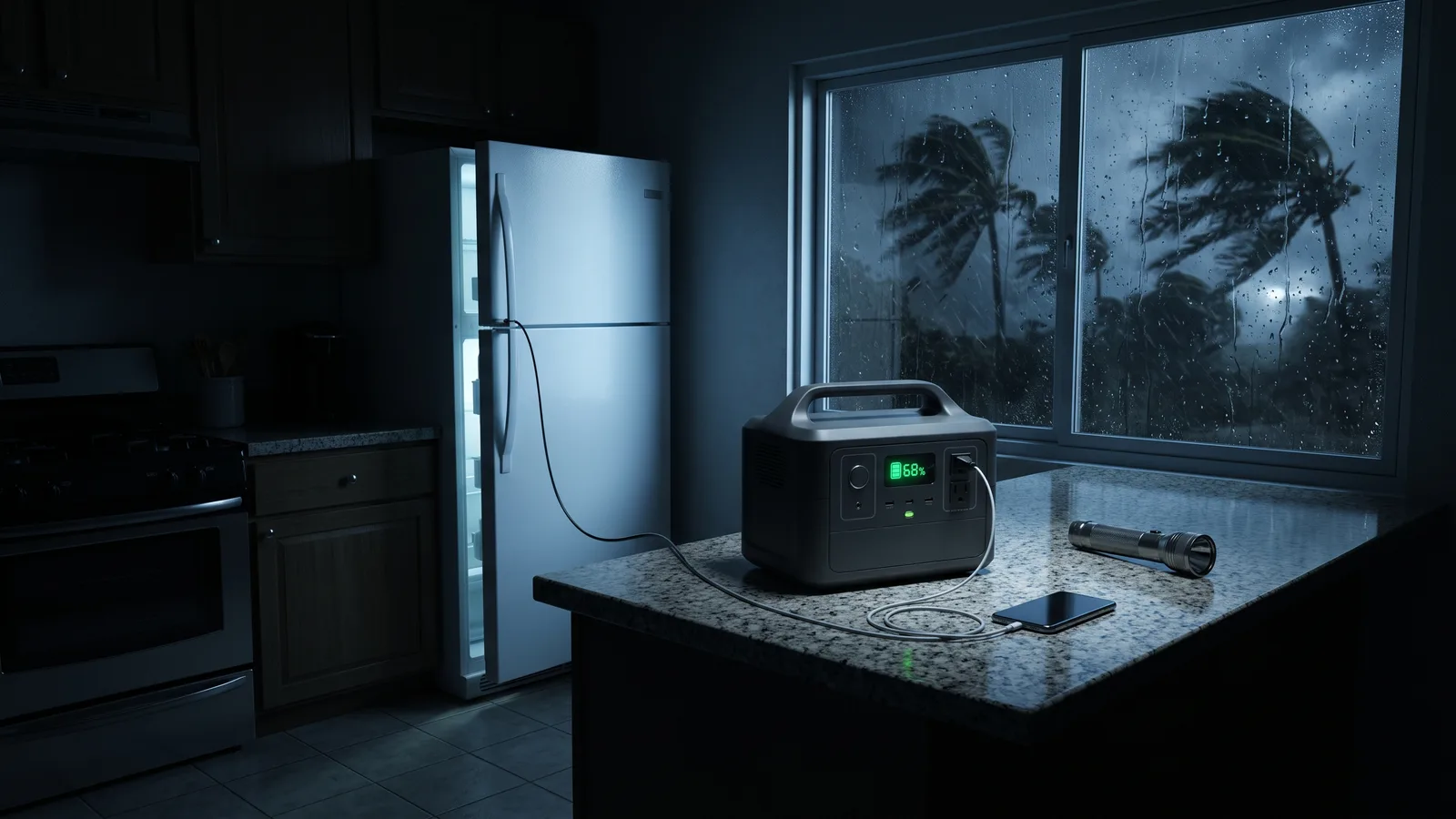
Hurricane season runs June through November in Florida, and power outages are one of the most predictable parts of it. A portable power station is quiet, safe to use indoors, and ready the moment the lights go out — no fuel runs, no extension cords through a window, no carbon monoxide risk.
This guide breaks down what to look for and compares the models most Florida homeowners are buying this season, based on manufacturer specs and owner reviews.
Quick picks
- Best overall for hurricane prep: EcoFlow Delta 3 Max Plus — fast recharge speed matters when a storm gives you only a short warning
- Best value: Anker SOLIX C1000
- Best for running a fridge multiple days: Jackery HomePower 3000
- Best compact option for apartments/condos: Jackery Explorer 500
- Best expandable system: EcoFlow Delta Pro 3
Why portable power stations make sense in Florida
Gas generators need fuel, and fuel lines around Florida gas stations get long fast once a storm enters the forecast cone. Generators also need to run outdoors, away from windows and doors, which isn’t always practical in dense neighborhoods or condos.
A power station charges from a normal wall outlet days ahead of the storm. It sits quietly indoors, produces no fumes, and can be recharged again later with a portable solar panel if the outage runs long.
The tradeoff is capacity. Power stations can’t match a whole-house generator for running central air conditioning, but they’re plenty for the loads that matter most during a short-to-medium outage: refrigeration, lights, fans, phones, and medical devices.
How to size a power station
Two numbers matter:
- Capacity (Wh): how much total energy the battery stores
- Continuous output (W): how much power it can deliver at once, which determines what appliances it can run
| Household need | Capacity | Continuous output |
|---|---|---|
| Phones, lights, router | 300–600Wh | 300W+ |
| Add fans, laptop, CPAP | 1,000–1,500Wh | 600W+ |
| Add a refrigerator | 2,000–3,000Wh | 1,800W+ |
| Fridge + microwave + window AC unit | 3,000Wh+ | 3,000W+ |
Refrigerators draw a short burst of extra power (“surge”) when the compressor kicks on, sometimes 2–3x their running wattage. Check a power station’s surge rating, not just its continuous rating, before assuming it can handle your fridge.
Model comparison
| Model | Capacity | Continuous output | Recharge time (AC) | Best for |
|---|---|---|---|---|
| Jackery Explorer 500 | ~518Wh | 500W | ~4-5 hrs | Small households, apartments |
| Anker SOLIX C1000 | ~1,056Wh | 1,800W | ~1 hr | Budget-conscious buyers wanting real output |
| Bluetti AC180 | ~1,152–1,700Wh | 1,800W | ~1 hr | Fans, CPAP, laptops, some fridge use |
| EcoFlow Delta 3 Max Plus | ~3,000Wh+ | 3,600W | ~50 min to 80% | Multi-day outages with fridge |
| Jackery HomePower 3000 | ~3,072Wh | 3,600W (7,200W surge) | Several hours | Longer outages, whole-home essentials |
| EcoFlow Delta Pro 3 | 4,096Wh (expandable) | 4,000W | Varies | Homes wanting to scale up over time |
Always confirm current specs on the manufacturer’s site before buying, since firmware and hardware revisions change year to year.
Features that matter more in Florida specifically
Fast AC recharge. Storm warnings can shrink from 5 days to 2 overnight. A unit that recharges from empty to mostly full in under an hour is far more forgiving than one that takes 5-6 hours.
Humidity and heat tolerance. Florida garages and sheds get hot. Look for units rated to operate in high-heat environments, and avoid storing a power station in direct sun or an uninsulated attic.
Expandability. Some systems (like the EcoFlow Delta Pro 3) let you add extra battery modules later. This is useful if you want to start smaller this year and grow your system before next hurricane season.
App monitoring. Most current models pair with a phone app so you can check charge level and runtime estimates without opening the unit — handy for checking on the fridge overnight.
FAQ
Can a portable power station run my whole house? No. Portable power stations are built for essential loads — fridge, fans, lights, phones, medical devices — not whole-house central air or a well pump running continuously. For whole-house backup, you need a standby or large fuel generator, or a much larger home battery system.
How long can I store a power station without using it? Most lithium units hold charge well for months. Manufacturers typically recommend topping off to 50-80% every few months during the off-season to preserve battery health — check your model’s manual.
Are these safe to use indoors during a storm? Yes, that’s one of their main advantages over gas generators. They produce no exhaust fumes, so they can run in a closet, garage, or living room safely.
Do I need a solar panel too? Not required, but a solar panel is worth it if you expect outages longer than 2-3 days. It lets you recharge the station during daylight even if grid power stays out, effectively giving you unlimited runtime for essentials.