Running Portable AC on Backup Power During a Florida Outage
By Hilario Herrera · Last updated ·Research-based guide · Some links are paid links (disclosure).
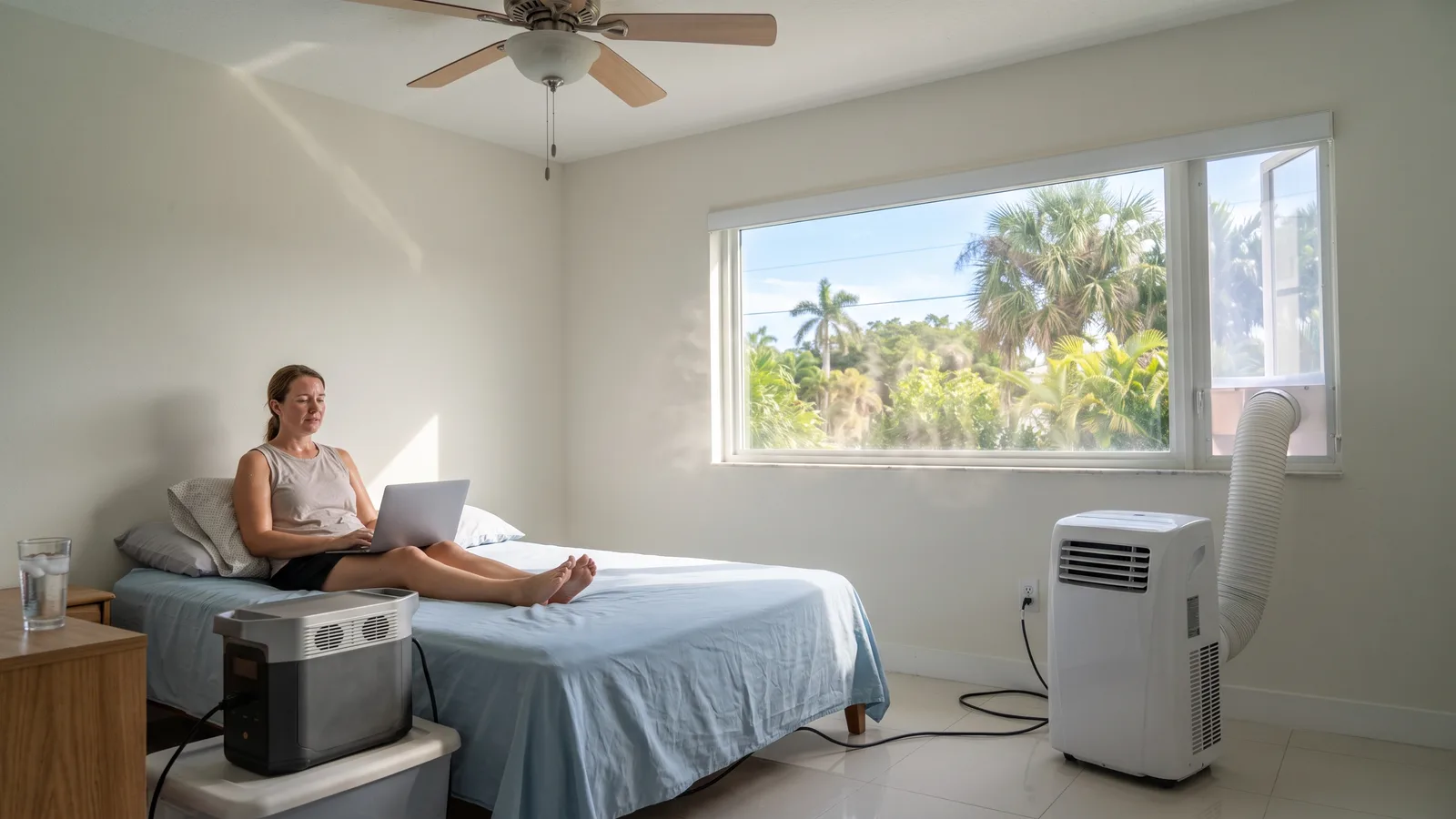
Losing power during a Florida summer isn’t just uncomfortable — indoor temperatures can climb into the 90s within hours, which is a real heat-safety concern for kids, older adults, and pets. Central AC is usually too power-hungry for anything but a whole-house generator, but a portable AC unit is a realistic option to run on backup power in a single room. Here’s what it actually takes.
Quick picks
- Best portable AC for generator/battery use: Midea Duo 12,000 BTU
- Best low-power portable AC: BLACK+DECKER 8,000 BTU Portable AC
- Best generator to power it: Champion 4500W Inverter Generator
- Best power station for short-run AC use: EcoFlow Delta Pro 3
How much power does a portable AC need
Portable AC units are rated by BTU (cooling capacity), but what matters for backup power is running watts and, more importantly, starting watts — the surge a compressor draws for a second or two when it kicks on. That surge is often 2-3x the running wattage and trips up a lot of underpowered generators and power stations.
| Portable AC Size | Running Watts (approx.) | Starting Watts (approx.) |
|---|---|---|
| 8,000 BTU | 700–900W | 1,500–2,000W |
| 10,000 BTU | 900–1,200W | 1,800–2,500W |
| 12,000 BTU | 1,100–1,500W | 2,200–3,000W |
| 14,000 BTU | 1,300–1,800W | 2,600–3,500W |
Check the yellow EnergyGuide label or spec sheet on your specific unit — actual wattage varies by manufacturer and efficiency rating (SACC vs. ASHRAE BTU ratings can make two “12,000 BTU” units draw different amounts of power).
Generator sizing
A portable inverter generator needs enough surge capacity to cover the AC’s startup spike, plus headroom for anything else running (lights, fridge, phone chargers). As a rule of thumb:
- An 8,000-10,000 BTU unit can usually run on a 2,200-2,500W inverter generator (like a Honda EU2200i) with little else on the circuit.
- A 12,000+ BTU unit is safer paired with a 3,500-4,500W generator, which gives enough surge headroom to also run a fridge or a few lights simultaneously.
- Many modern portable AC units, and most modern generators, have “soft start” technology that reduces the surge — some portable ACs advertise soft-start compressors specifically for generator compatibility, which is worth checking if generator size is a constraint.
Power station sizing
Battery power stations can run a portable AC too, but capacity (not just wattage) becomes the limiting factor quickly. A 12,000 BTU AC drawing roughly 1,200 running watts will drain a 2-3kWh power station (like the EcoFlow Delta Pro 3 or Jackery Explorer 2000 Plus) in under 2 hours of continuous run time — useful for cooling a room down before bed or during the hottest part of the day, but not a realistic all-night, whole-outage solution unless you add solar recharging or a much larger battery capacity.
For longer backup, look at power stations with expandable battery packs (several EcoFlow and Anker models support add-on battery modules), which can push total capacity to 6-12kWh and stretch AC run time to several hours at a stretch.
Tips to stretch your run time
- Cool one room, not the house. Close doors, hang a blanket or towel over doorways, and focus the AC’s airflow on the room you’re sleeping or gathering in.
- Run it in bursts. Cool the room down, then switch off the AC and run just a fan to maintain the temperature for a while before cooling again.
- Seal the exhaust hose properly. A poorly sealed portable AC exhaust hose lets hot outside air leak back in, forcing the unit to work harder and draw more power for less cooling.
- Pair with a fan instead of running AC continuously. A box fan draws a fraction of the wattage and can make a room feel several degrees cooler when combined with brief AC bursts.
Safety notes
- If using a gas generator, run it outdoors only, at least 20 feet from windows, doors, and vents, per CDC and CPSC carbon monoxide guidance. Never run it in a garage, carport, or under a covered porch, even with doors open.
- Keep a battery-powered carbon monoxide detector in the home during any outage where a generator is in use nearby.
- Portable AC units also need proper drainage or a way to empty condensate; check your manual, since some models require manual draining more often when run continuously off-grid.
- Watch for heat-related illness symptoms (dizziness, nausea, confusion, rapid pulse) in household members, especially children, older adults, and pets, if cooling capacity is limited — consider a cooling center or relocating temporarily if indoor temperatures can’t be kept safe.
FAQ
Can a power station run a portable AC all night? Usually not on a single charge for standard consumer units (2-3kWh). Expect 1-3 hours of continuous run time; expandable battery systems or solar recharging can extend this.
Do I need a special outlet or transfer switch to run a portable AC on a generator? No — a portable AC simply plugs into a standard outlet on the generator or power station, the same as at home. No electrical work is required, unlike whole-house generator setups.
Is a window AC unit more efficient than a portable AC for backup power? Yes, generally. Window units tend to be more energy-efficient per BTU than portable units because they don’t lose cooling through an exhaust hose, so they can be a better choice if your outage setup allows for one and your window configuration supports it.
What size generator do I need to run a portable AC and a refrigerator together? Add the running watts of both plus the higher of their two starting watts (since they rarely start simultaneously) — typically a 12,000 BTU AC plus a fridge lands around 3,500-4,500W total generator capacity as a comfortable target.
Will running a portable AC on a generator damage the AC unit? Not if the generator’s power is stable and within the AC’s voltage tolerance. Inverter generators (as opposed to older conventional generators) produce cleaner power closer to grid quality, which is generally recommended for sensitive electronics and compressor-driven appliances — check your AC manufacturer’s generator compatibility guidance if concerned.