Solar vs Grid: What Does It Really Cost to Charge a Power Station in Florida?
By Hilario Herrera · Last updated ·Research-based guide · Some links are paid links (disclosure).
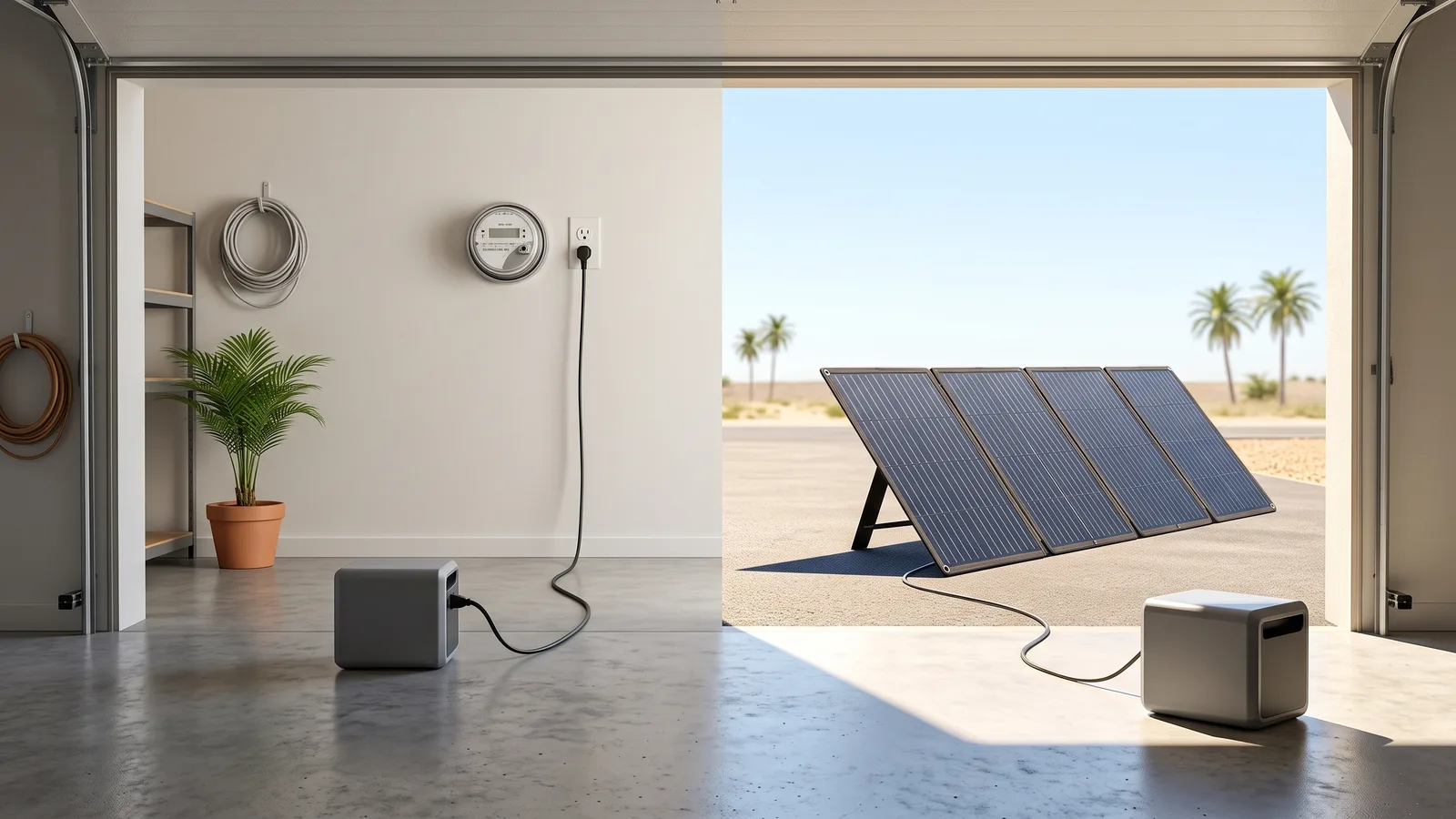
If you own (or are considering) a portable power station, one practical question rarely gets a straight answer: is it actually cheaper to recharge it from solar panels, or just from a wall outlet? The honest answer depends heavily on how much you already paid for solar equipment and how often you recharge — this article walks through the math using Florida’s current average electricity rate so you can run your own numbers.
Quick Picks
| If you mostly… | Consider | Why |
|---|---|---|
| Charge occasionally at home | Standard AC wall charger / included cable | Grid charging cost is trivial per session; solar payback isn’t worth it for occasional use |
| Camp or boondock regularly | 100–200W portable solar panel | Free recharging off-grid pays for itself faster with frequent use |
| Want backup during outages | Power station + solar panel bundle | Solar keeps the unit usable even when grid power is down |
| Charge daily / off-grid full-time | Larger fixed or higher-wattage folding solar array | Faster recharge and better long-run cost-per-kWh with heavier use |
Florida Grid Electricity Cost: The Baseline Number
As of mid-2026, Florida’s average residential electricity rate is commonly reported in the range of roughly 15–16 cents per kWh, which is below the national average. This figure varies by utility — for example, published 2026 rate data shows different figures for FPL versus Duke Energy Florida customers — so check your own utility bill for your exact rate rather than relying on a statewide average.
Cost to Fully Charge a Power Station from the Grid
The grid-charging cost of a power station is straightforward: capacity (kWh) × your electricity rate ($/kWh) ÷ charging efficiency. Power stations lose some energy as heat during charging (commonly modeled around 85–90% efficiency for AC charging, though this varies by unit), so real-world cost is slightly higher than the raw capacity math suggests.
Using an illustrative Florida grid rate of $0.155/kWh:
| Power Station Capacity | Rated Capacity (kWh) | Approx. Grid Cost per Full Charge* |
|---|---|---|
| 300Wh | 0.3 kWh | ~$0.05–$0.06 |
| 1,000Wh | 1.0 kWh | ~$0.17–$0.18 |
| 2,000Wh | 2.0 kWh | ~$0.34–$0.36 |
| 4,000Wh | 4.0 kWh | ~$0.68–$0.72 |
*Estimates include a rough allowance for charging inefficiency; actual cost depends on your specific rate and unit’s real-world efficiency.
The headline takeaway: grid-charging a power station is genuinely inexpensive per session, even in a state with plenty of expensive-electricity headlines elsewhere in the country. A full charge on most consumer units costs well under a dollar at Florida’s average rate.
Cost to Charge from Solar: Where the Math Gets Different
Charging from solar panels has no per-session electricity cost — the “fuel” is free once you own the equipment. The real cost is the upfront price of the solar panel(s), amortized over however many charge cycles you actually use them for. This is the classic solar payback calculation, scaled down to power-station size instead of whole-home size.
A simplified way to think about it: panel cost ÷ number of full charges over the panel’s useful life = effective cost per charge. If a portable solar panel is a budget-tier purchase (check the live listing for the actual price) and you use it to fully recharge a power station a few times a week for years, the effective per-charge cost drops toward zero over time — but if you only use it a handful of times a year, the grid may remain cheaper in practice for a long time, since the panel’s upfront cost is spread over very few charging sessions.
Comparison Table: Solar vs Grid Charging
| Factor | Grid Charging | Solar Charging |
|---|---|---|
| Upfront cost | None (uses existing outlet) | Cost of solar panel(s), typically ranging from budget portable kits to higher-wattage arrays |
| Per-charge cost | Small but nonzero (fraction of a dollar at FL rates) | Effectively $0 once equipment is owned |
| Speed | Generally fastest, especially with a fast AC charger | Depends on sun conditions and panel wattage; slower and variable |
| Works during power outages | No | Yes — a key advantage during hurricane season |
| Best for | Occasional or convenience charging at home | Frequent off-grid use, camping, or backup preparedness |
When Solar Actually Pays Off
Solar charging tends to make the most financial sense when:
- You recharge frequently (regular camping, boondocking, or daily off-grid use)
- You already own or plan to buy the panel for other reasons (RV setup, backup preparedness)
- Grid access isn’t reliably available where you’re charging
- You value resilience during power outages as much as raw cost savings
If you mostly top off a power station a few times a year at home, the grid-charging cost is low enough in Florida that a dedicated solar panel purchase may take a long time to “pay for itself” purely in electricity savings — though it can still be worth it for backup-power peace of mind during hurricane season.
FAQ
Is it actually cheaper to charge a power station from solar than from the wall in Florida? Per charging session, yes — solar has no marginal electricity cost. But once you include the upfront cost of a solar panel, grid charging is often cheaper in total cost unless you recharge very frequently, since Florida’s grid rate is relatively low.
What is Florida’s average electricity rate right now? Reported figures for 2026 generally cluster around 15–16 cents per kWh on average, though your actual utility rate depends on your provider — check your bill or utility website for the precise current rate.
How much does it cost to fully charge a 1,000Wh power station from the grid in Florida? At an illustrative rate near $0.155/kWh and accounting for charging losses, a full charge on a 1,000Wh-class unit costs roughly 17–18 cents — a small amount per session, even if you do it often.
Does solar charging make sense if I only camp a few times a year? Possibly not from a pure cost-recovery standpoint, since the panel’s upfront cost is spread across very few charging sessions — but it may still be worth it if you value off-grid capability or hurricane-season backup power regardless of the payback math.
Does charging efficiency really matter in this comparison? Yes, to a modest degree — both grid (AC) and solar (DC) charging paths lose some energy as heat, so the real cost per full charge is slightly higher than a simple capacity-times-rate calculation. It doesn’t change the overall conclusion, just the precise numbers.