Battery Backup for Home: What Florida Households Actually Need (2026)
By Hilario Herrera · Last updated ·Research-based guide · Some links are paid links (disclosure).
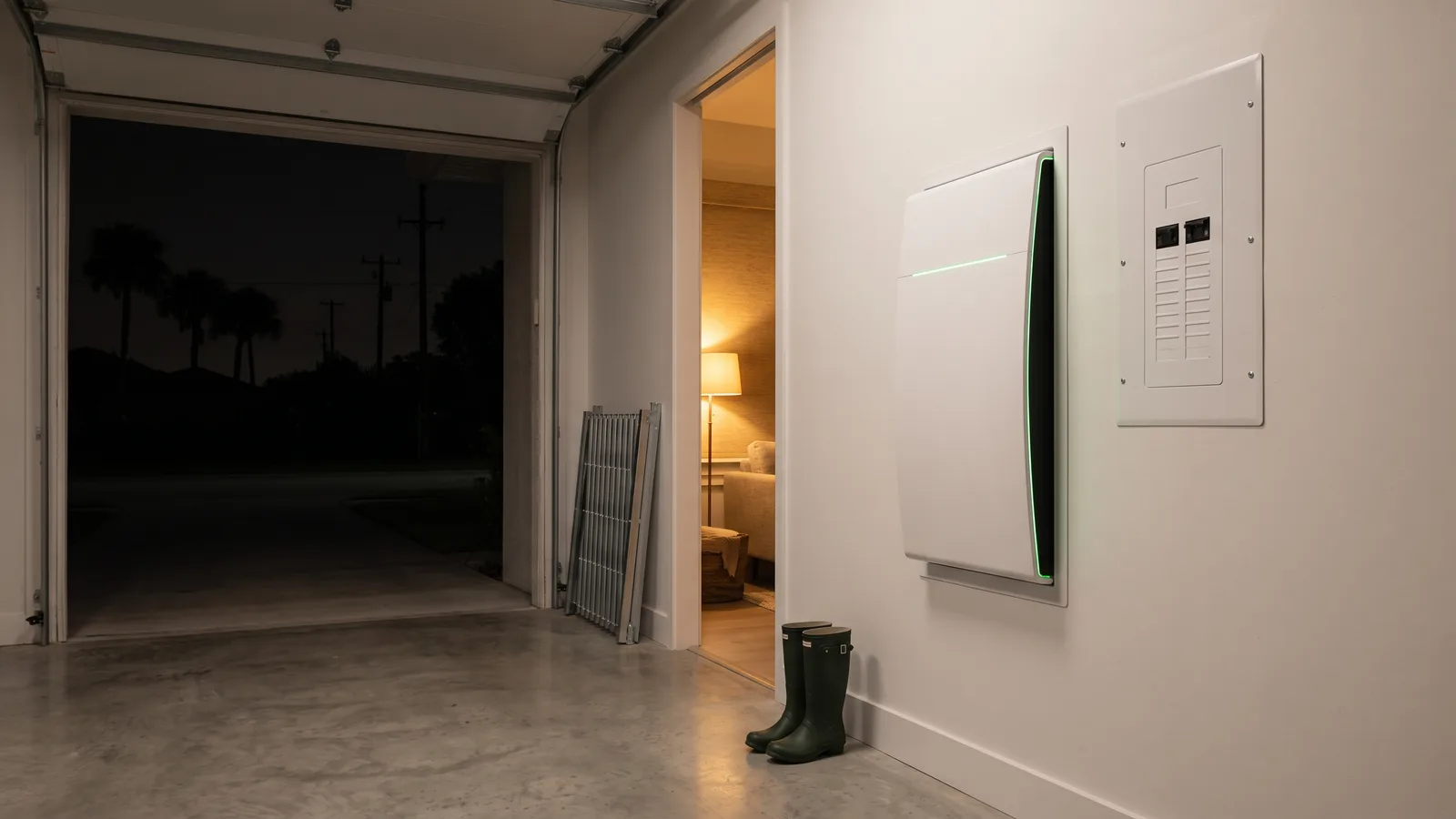
A home battery backup stores electricity and releases it when the grid goes down. Three tiers exist: portable power stations (1–4 kWh, plug and play), expandable systems (4–12 kWh, transfer switch optional), and whole-home installed batteries (10 kWh and up, permitted, e.g. Franklin or Tesla Powerwall class). Florida outage length decides which tier fits.
Battery backup for home: the three tiers explained
Everything on the market falls into one of three buckets, and the gap between them is measured in thousands of dollars and days of permitting.
Tier 1 — Portable power station (1–4 kWh). A box with an inverter, outlets, and a lithium battery. You plug appliances directly into it. No electrician, no permit, no permanent install. Handles a fridge, fans, phones, laptops, a CPAP, and lights.
Tier 2 — Expandable modular system (4–12 kWh). Same concept, but you bolt on extra battery modules and can add a manual transfer switch or a smart panel so a few household circuits run on it. Still owner-installable at the base level; the transfer switch is the part an electrician touches.
Tier 3 — Whole-home installed battery (10 kWh+). Permanently wired into your electrical panel with an automatic transfer gateway. It switches over in milliseconds, so you may not notice the outage started. Requires a licensed installer, permits, and a utility interconnection application in most Florida counties.
Comparison table
| Portable power station | Expandable system | Whole-home installed | |
|---|---|---|---|
| Capacity | 1–4 kWh | 4–12 kWh | 10–40 kWh (stackable) |
| Cost range (approx.) | Budget to mid-range tier | Mid-range to premium tier | $12,000–$20,000 per unit installed |
| What it runs | Fridge, fans, lights, phones, CPAP, TV, small appliances | Above plus a window AC or mini-split, well pump on some models, sump pump | Most or all circuits including central AC, in many configurations |
| Install needs | None — unbox and plug in | Optional transfer switch (electrician, ~$500–$1,500) | Licensed installer, permit, utility interconnection, 1–3 months lead time |
| Automatic switchover | No | Only with a smart panel | Yes |
| Typical runtime | 12–36 hours of essentials | 1–3 days of essentials | 1–3 days, longer with solar |
| Portable/takeable | Yes | Partly | No |
Reported 2026 pricing puts a single installed Tesla Powerwall 3 (13.5 kWh) in the rough $12,000–$16,500 range, and a FranklinWH aPower 2 around $15,000–$20,000 installed including the aGate controller. Treat these as approximate — Florida quotes vary widely by county, panel condition, and installer backlog. Note also that the federal residential clean energy credit for standalone batteries expired at the end of 2025, so 2026 pricing is what you actually pay.
Home battery backup system: what to size it for in Florida
Size for the loads you refuse to live without, not for your whole electric bill. In Florida that list is short and specific.
A full-size fridge draws roughly 1–2 kWh per day once you account for its duty cycle. This is the single most common reason people buy a battery.
Fans and lights are cheap — a box fan is around 50–75 watts, LED lighting is negligible. A 2 kWh station can run fans overnight without stress.
Medical equipment. A CPAP without the heated humidifier is roughly 30–60 watts, so under 0.5 kWh per night. With the humidifier on, it can triple. Turn the humidifier off during an outage.
Central air conditioning is the wall everyone hits. A typical Florida central AC pulls 3,000–5,000 watts running with a much higher startup surge. Only tier 3 systems, or a large tier 2 setup running a single mini-split, do this credibly. A portable unit will not run your central AC, and any product page implying otherwise is worth skepticism.
Florida-specific factors nobody mentions in national guides
Outage duration is the real variable. Florida outages are bimodal: routine afternoon thunderstorm blips of a few minutes to an hour, and post-hurricane restoration that can stretch several days to over a week in the hardest-hit areas. Sizing for the first case is trivial. Sizing for the second is what actually costs money.
Heat makes the outage worse and the battery weaker. Losing power in August is not the same as losing it in January. Indoor temperatures climb fast, food spoils faster, and lithium batteries themselves lose capacity and age quicker when stored hot. Keep any battery indoors in conditioned space, not in the garage or a shed — that is where Florida owners quietly kill their equipment.
No gas logistics. This is the underrated argument for batteries over generators. After a major storm, gas stations without power cannot pump, lines run hours long, and stored gasoline degrades. A battery paired with solar panels refuels itself from a resource Florida has in surplus. It is also silent, produces no carbon monoxide, and can sit inside your house — none of which is true of a portable generator, which kills people every hurricane season through improper placement.
Storm-season charging discipline. Whatever you buy, top it off when a system enters the Gulf, not when the wind arrives. Batteries self-discharge slowly in storage, and a unit at 40% when the lights go out is a unit that has already failed you.
Whole home battery backup: when it’s actually worth it
Whole-home makes sense in a narrower set of cases than the marketing implies.
It’s worth it if you already have or are installing rooftop solar (the battery and the array share equipment and labor, and solar is what turns a 1-day battery into an indefinite one), you have a medical dependency on cooling or powered equipment, you work from home and lost income exceeds the payback math, or you’re on a well and septic system where losing the pump means losing water.
It’s probably not worth it if your outages are typically short, you rent, you’re planning to move within a few years, or the only thing you truly need is a fridge and some fans. The cost gap between a mid-range portable unit and a $16,000 installed system buys a lot of hotel nights.
The honest middle path most Florida households land on: a solid portable or expandable station for food, fans, and devices, plus a plan to leave if a storm knocks out power for more than 48 hours in August. That combination costs a fraction of a whole-home install and covers the overwhelming majority of real outages.
Best battery backup for home: three configurations worth researching
These are the units that come up most often for Florida use cases. Research the current specs before buying — capacities and bundles change frequently.
Mid-size, expandable, LiFePO4 — EcoFlow DELTA 3 Plus (paid link). A ~1 kWh base unit that accepts expansion batteries, with fast AC recharging and solar input. Good fit for a household that wants fridge-and-fans coverage now with the option to grow before next season.
Larger single-box capacity — Anker SOLIX C2000 Gen 2 (paid link). Roughly 2 kWh in one chassis with a high continuous output rating, which matters for appliances with heavy startup surge. A reasonable one-unit answer for multi-day fridge duty.
Top of the portable tier — EcoFlow DELTA Pro 3 (paid link). Around 4 kWh expandable well beyond that, 120V/240V output, and compatible with transfer-switch setups. This is the unit that blurs into tier 2 and can be wired to select household circuits — the closest you get to whole-home behavior without a permitted install.
FAQ
How long will a home battery backup run my fridge? A 2 kWh station typically runs a full-size modern fridge for roughly 24 hours, and an efficient one longer, because the compressor cycles rather than running continuously. Older or larger units cut that down. Add solar panels and the number becomes open-ended in Florida sun.
Can a portable power station run central air conditioning? Realistically, no. Central AC in Florida homes pulls thousands of watts continuously with a large startup surge, and would drain a portable battery in under an hour even if the inverter could handle the surge. A single window unit or an efficient mini-split is the practical ceiling for large portable systems.
Is a home battery better than a generator for hurricanes? Each wins on different points. Batteries are silent, indoor-safe, maintenance-free, and refuel from solar. Generators deliver far more sustained power for less upfront money but require fuel you may not be able to buy after a storm, and must be run well away from the house. Many Florida households end up owning both.
Do I need a permit for a home battery backup system in Florida? Not for a portable unit you plug appliances into — that is just an appliance. You do need permitting, a licensed electrician, and usually a utility interconnection application for anything hardwired into your panel, including transfer switches and whole-home batteries. Requirements vary by county and municipality, so confirm locally before you buy.
Some links above are affiliate links. Prices and specifications cited are approximate and were current at the time of writing; verify before purchasing.