Best Portable Power Stations Under $500 in 2026 (Florida Buying Guide)
By Hilario Herrera · Last updated ·Research-based guide · Some links are paid links (disclosure).
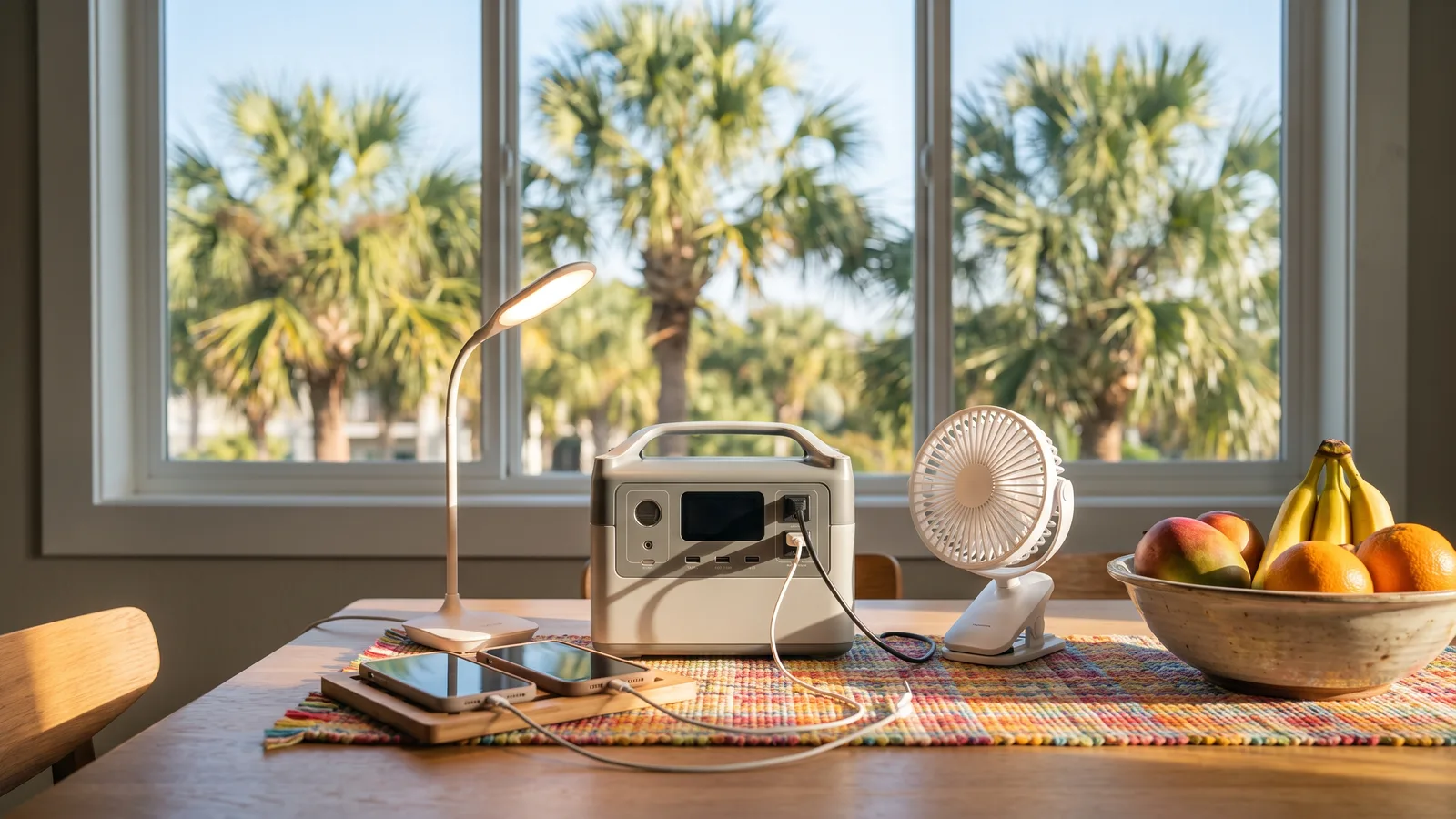
You don’t need a premium-tier battery to get real outage protection. The 2026 lineup of sub-$500 power stations has gotten genuinely good, with most now using LiFePO4 battery cells rated for 3,000+ charge cycles instead of the shorter-lived lithium-ion cells that used to dominate this price range. Below is a comparison of the current best options under $500, based on manufacturer specs and cross-checked buying-guide data.
Quick picks
- Best overall value: Jackery Explorer 1000 v2 — 1,070Wh, and sales regularly drop it into the budget tier.
- Best true budget pick: EcoFlow RIVER 3 — 245Wh, firmly in the budget tier, good for phones/fans/laptops.
- Best mid-tier balance: Bluetti AC70 — 768Wh / 1,000W, top of the budget tier.
- Best for fast charging on a budget: Anker SOLIX C1000 — budget tier when it is on sale, with faster charge times than most competitors at this price.
Why capacity under $500 matters more than watts
At this price point, manufacturers advertise big peak-wattage numbers, but for outage prep the number that actually matters is watt-hours (Wh) — total stored energy. A higher peak wattage just means you can run a higher-draw appliance briefly; it doesn’t mean you can run it longer. For Florida outages where you’re mainly keeping a fridge, fans, phones, and a modem alive, prioritize Wh capacity and realistic runtime over peak wattage claims.
Comparison table
| Model | Capacity | Output | Battery Type | Price tier |
|---|---|---|---|---|
| EcoFlow RIVER 3 | 245Wh | 300W | LiFePO4 | $ budget |
| Bluetti AC70 | 768Wh | 1,000W | LiFePO4 | $ budget |
| EcoFlow DELTA 3 Classic | 1,024Wh | ~2,000W-class output | LiFePO4 | $ budget |
| Anker SOLIX C1000 | ~1,024Wh | 1,800–2,000W | LiFePO4 | $ budget (on sale) |
| Jackery Explorer 1000 v2 | 1,070Wh | 1,500W | LiFePO4 | $ budget (on sale) |
| Bluetti Elite 100 V2 | ~1,000Wh class | Quiet operation, ~30dB | LiFePO4 | $ budget (on sale) |
Check on Amazon: EcoFlow RIVER 3, Bluetti AC70, EcoFlow DELTA 3 Classic, Anker SOLIX C1000, Jackery Explorer 1000 v2, Bluetti Elite 100 V2
Spec table (no prices)
The same models, stripped to the specs that decide whether a unit fits your outage plan. Blank cells mean we do not have a figure we can verify from the manufacturer listing — we would rather show a gap than a guess.
| Model | Capacity (Wh) | Output (W) | Weight | Battery chemistry | Warranty |
|---|---|---|---|---|---|
| EcoFlow RIVER 3 | 245 | 300 | — | LiFePO4 | — |
| Bluetti AC70 | 768 | 1,000 | — | LiFePO4 | — |
| EcoFlow DELTA 3 Classic | 1,024 | ~2,000-class | — | LiFePO4 | — |
| Anker SOLIX C1000 | 1,024 | 1,800–2,000 | — | LiFePO4 | — |
| Jackery Explorer 1000 v2 | 1,070 | 1,500 | — | LiFePO4 | — |
| Bluetti Elite 100 V2 | ~1,000-class | — (rated ~30 dB operation) | — | LiFePO4 | — |
Cycle life is the spec that does have a consistent published answer here: LiFePO4 cells in this class are commonly rated for 3,000+ cycles to 80% capacity.
What you can realistically run
Based on manufacturer runtime charts and appliance wattage averages:
| Appliance | Typical Draw | Runtime on 245Wh unit | Runtime on ~1,000Wh unit |
|---|---|---|---|
| Wi-Fi router/modem | 10–15W | ~15+ hours | ~60+ hours |
| Box fan | 45–75W | ~3–5 hours | ~13–20 hours |
| Full-size fridge (cycling) | 100–200W avg | Not recommended long-term | ~8–14 hours cumulative |
| CPAP machine | 30–60W | ~4–7 hours | ~16–28 hours |
| Laptop charging | 45–65W | Multiple charges | Many charges |
These are estimates from manufacturer specs, not lab-tested figures, so treat them as a planning guide rather than a guarantee.
Florida-specific buying advice
For hurricane prep specifically, a sub-$500 unit is best treated as backup for essentials, not a whole-house solution. A 1,000Wh-class unit paired with a portable solar panel can realistically keep a fridge cycling, phones charged, and a fan running through a multi-day outage if you can get a few hours of sun each day — which is usually not hard to find in Florida even after a storm passes. If your priority is strictly the lowest price for basic phone/light/fan backup, the smaller sub-300Wh units (RIVER 3 class) are enough and leave more budget for solar panels or a NOAA weather radio.
Humidity is also a factor for anything left in a garage or shed for months between storms — LiFePO4 tolerates Florida humidity well, but manufacturers generally recommend indoor, dry storage away from direct sun when not in use.
What to skip at this price
Not every listed “under $500” deal holds up. Watch out for:
- Non-LiFePO4 batteries in older or clearance models — these degrade faster and are less heat-tolerant, which matters in Florida.
- Low solar input wattage — some budget units cap solar charging low enough that recharging via panels takes a full day or more.
- Missing pass-through charging — a real feature gap on some cheaper units, meaning you can’t charge devices while the station itself is plugged in and charging.
FAQ
Is a 245Wh unit big enough for hurricane season? It covers phones, small fans, and a modem/router, but not a fridge for any meaningful stretch. If a fridge or CPAP is a priority, budget for the 1,000Wh class instead.
Do these under-$500 units support solar charging? Most current models do, though solar input wattage varies by brand and model — check the specific listing, since this is one of the biggest differentiators at this price point.
How many charge cycles do LiFePO4 batteries in this price range last? Manufacturer specs commonly cite 3,000+ cycles to 80% capacity, which for typical occasional-outage use translates to roughly a decade of useful life.
Are sale prices reliable, or should I wait for a specific event? EcoFlow, Jackery, Anker, and Bluetti all run frequent discounts, especially around hurricane season (June) and Black Friday. If you’re not in an immediate-need situation, watching for a sale can meaningfully lower the price on 1,000Wh-class units.
Can I run a window AC unit on any of these? Generally no — window AC units typically draw 500–1,200W continuously, which will drain even a 1,000Wh unit in under two hours and may exceed some models’ continuous output rating. For AC backup, look at 2,000Wh+ units instead.