Anker SOLIX Lineup Explained: C300 vs C1000 vs F2000 vs F2600 for Florida (2026)
By Hilario Herrera · Last updated ·Research-based guide · Some links are paid links (disclosure).
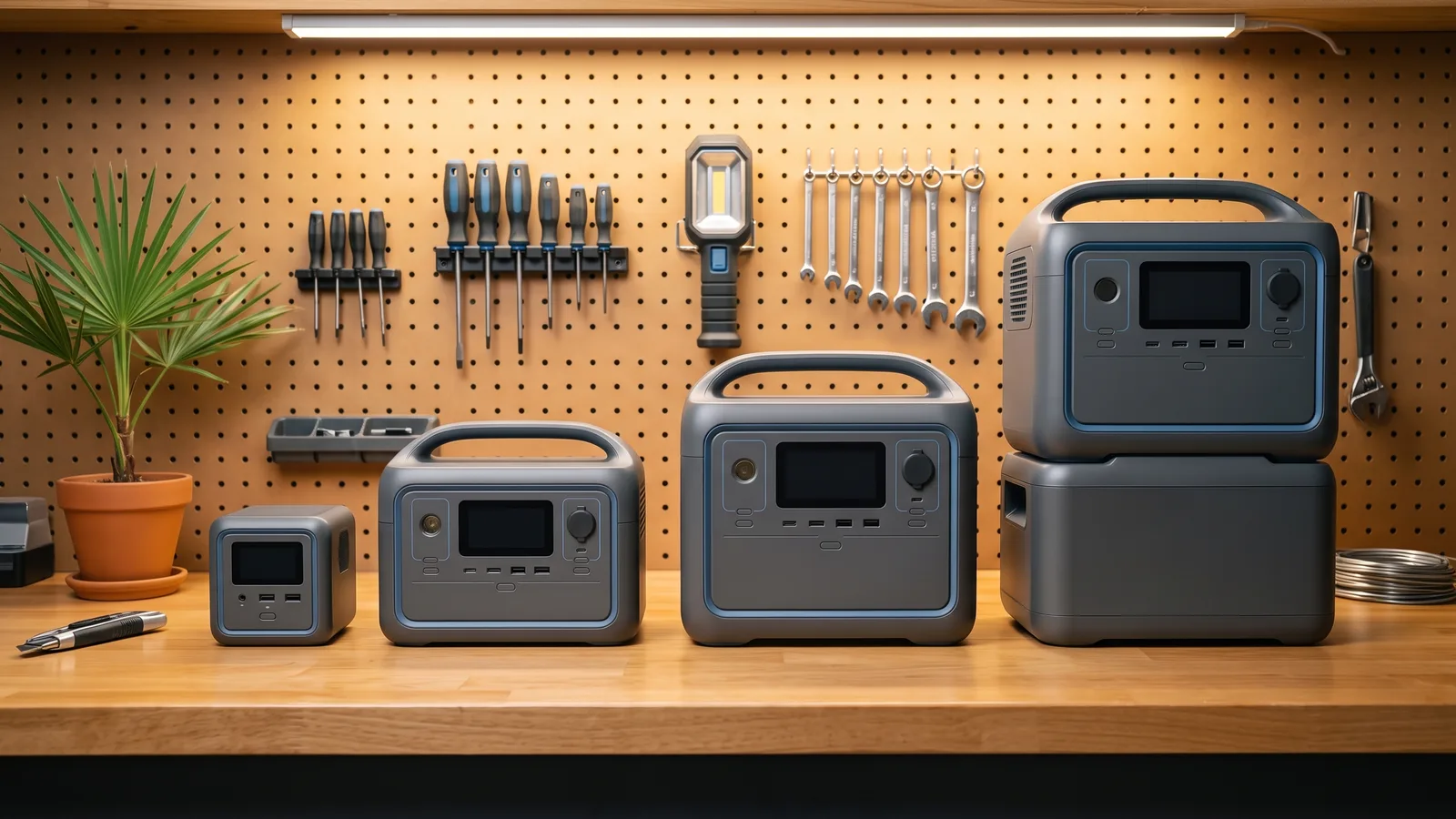
Most Florida households land in one of four places: the C300 (288Wh) for a CPAP and phones, the C1000 Gen 2 (1024Wh) for a fridge plus devices through a one-day outage, the F2000 (2048Wh) for multi-day storm backup, and the F2600 (2560Wh) when you want expandable capacity and a 30-amp RV outlet.
Anker’s SOLIX line splits into two families that are easy to confuse. The C series is the compact, carry-it-with-one-hand tier built around fast charging and camping duty. The F series is the home-backup tier: heavier, higher-output, expandable with add-on batteries, and priced accordingly. Every model below uses LiFePO4 (LFP) cells, which is the spec that actually matters in Florida — LFP tolerates heat and humidity far better than older NMC chemistry and is rated for roughly 3,000 cycles before dropping to 80% capacity.
Spec comparison at a glance
| Model | Capacity | AC output (peak) | Weight | Price tier | Best for |
|---|---|---|---|---|---|
| SOLIX C300 | 288Wh | 300W (600W) | ~9 lb | $ budget | CPAP, phones, laptops, camping |
| SOLIX C1000 Gen 2 | 1,024Wh | 2,000W (3,000W) | ~25 lb | $$ mid-range | Fridge + devices, 1-day outage |
| SOLIX C2000 Gen 2 | 2,048Wh | 2,400W (3,600W) | ~48-67 lb | $$ mid-range | Multi-day storm backup |
| SOLIX F2600 | 2,560Wh | 2,400W (2,800W) | ~62-70 lb | $$$ premium | Expandable backup, RV/TT-30 |
Prices on these units swing hard with Anker’s sale cycles — the F2600 in particular carries a high list price and is frequently discounted, so the tier above reflects typical street pricing rather than MSRP, and a good sale can pull a unit down a tier. Weight figures for the F-series vary between sources and configurations; treat them as “two-person lift” regardless.
Anker SOLIX C300: the CPAP and phone-charging pick
The C300 is the right buy if your outage plan is “keep the medical device and the phones alive,” not “keep the house running.” It packs 288Wh into a roughly 9-pound package with 300W of AC output (600W peak), three AC outlets, a 12V car socket, and 140W two-way USB-C charging that refills the unit to 80% in about 50 minutes from a wall outlet.
That 300W ceiling is the hard limit. It will not start a refrigerator compressor, and it will not run a window AC unit. What it does well: a CPAP without the humidifier runs roughly two nights on a full charge, and phones, tablets, LED lights, and a laptop stretch far longer. For a Florida apartment dweller or anyone who evacuates rather than shelters in place, the C300’s portability is the whole point.
Check current C300 price on Amazon (paid link)
Anker SOLIX C1000 Gen 2: the sweet spot for most homes
The C1000 Gen 2 is the model most Florida households should look at first, because it’s the smallest unit that can actually run a refrigerator. It holds 1,024Wh and delivers 2,000W continuous (3,000W peak) — a real jump over the original C1000’s 1,800W — while still weighing about 25 pounds and charging to full in roughly 49 minutes.
In practical terms, a modern Energy Star fridge draws somewhere around 1-2kWh per day, so a C1000 Gen 2 alone covers most of a day of refrigeration and not much else. Where it shines is cycling: plug it into solar during the day, run the fridge overnight, repeat. Its UPS passthrough also makes it useful year-round for a home office, which is a fair argument for buying this tier over a bigger unit that sits in a closet 51 weeks a year.
Check current C1000 Gen 2 price on Amazon (paid link)
Anker SOLIX C2000 Gen 2: multi-day backup at the best price per watt-hour
The F2000 is the value play in the F series and the entry point for genuine multi-day outage coverage. It stores 2,048Wh and pushes 2,400W continuous with a 3,600W surge rating — enough headroom for a fridge, a chest freezer, fans, a router, and lights simultaneously, with the surge capacity to handle compressor startup without tripping.
It has been on the market long enough that its discount pattern is well established, and it regularly undercuts the F2600 by a few hundred dollars for capacity that’s only about 25% smaller. If your goal is “keep food cold and stay connected for three or four days” and you don’t need an RV outlet, the F2000 is usually the better dollar-per-watt-hour buy.
Check current F2000 price on Amazon (paid link)
Anker SOLIX F2600: expandability and the 30-amp outlet
The F2600 is the F2000’s successor tier, and its advantages are capacity, ports, and expansion rather than raw output. It carries 2,560Wh with 2,400W continuous AC (2,800W surge), accepts up to 1,000W of solar input, and — critically — pairs with a BP2600 expansion battery to reach roughly 5,120Wh total. It also adds a NEMA TT-30 30-amp outlet alongside four standard 120V outlets, plus IP67-rated weather resistance.
That TT-30 port is the deciding feature for a lot of Florida buyers. If you own a travel trailer or plan to power an RV during an evacuation, the F2600 plugs straight in without an adapter dance. The expansion path also matters if you expect your needs to grow — buying an F2600 now and a BP2600 next season is cheaper and simpler than replacing a maxed-out unit.
Check current F2600 price on Amazon (paid link)
Which one for Florida hurricane season?
Start with duration, not capacity. Florida’s post-storm outages are commonly measured in days, not hours, and the honest question is how many days you need to cover and what you’re unwilling to lose.
- You evacuate, or you only need medical devices and comms: C300. Light enough to carry to a car or shelter, and it recharges from a car socket on the road.
- You shelter in place in an apartment or small home, fridge is the priority: C1000 Gen 2, paired with at least 200W of solar. Without solar, expect roughly one day. With solar, it becomes an indefinite fridge-and-devices setup in Florida sun.
- You shelter in place in a house with a fridge, freezer, and a few people: F2000. Three to four days realistically, longer with panels.
- You want room to grow, own an RV, or want a single unit that can expand past 5kWh: F2600.
Two Florida-specific notes. First, none of these units will run central air — that’s a whole-home generator or a large stackable system like the F3800, not a portable. Second, buy your solar panels at the same time. Anker’s own panels charge these units without configuration guesswork, and after a storm, panel stock disappears faster than the power stations do. A 200W panel array in Florida summer sun realistically returns 800-1,200Wh per day, which is what turns any of these from a countdown clock into a sustainable loop.
FAQ
Is the C300 enough for a CPAP? Yes, for most users. A CPAP without heated humidification typically draws 30-60W, which puts a 288Wh C300 at roughly two nights per charge. Turn the humidifier and heated hose off — they can triple consumption and cut you to a single night or less. If you can’t sleep without humidification, step up to the C1000 Gen 2.
Is the F2600 worth the upgrade over the F2000? Only for specific reasons. The extra 512Wh is about 25% more runtime, which is real but not transformative. The upgrade makes sense if you want the BP2600 expansion path to roughly 5,120Wh, need the TT-30 30-amp RV outlet, or want the 1,000W solar input and IP67 weather rating. If none of those apply and the F2000 is discounted, take the F2000 and put the savings toward panels.
Do they work with any solar panel? Mostly, within limits. All four accept third-party panels via their DC input as long as the panel’s open-circuit voltage and current stay inside the unit’s MPPT window — check the input spec printed on the unit before buying. Mismatched voltage is the usual failure point, not the connector. Anker’s first-party panels are the no-thinking option; third-party panels with an adapter cable work fine when the specs line up.
This guide is based on published manufacturer specifications and retailer listings as of August 2026. Prices change frequently — verify current pricing before purchasing. As an Amazon Associate, SunGrid Living earns from qualifying purchases.